
[Updated 11th December 2025]
Becoming a licensed security officer in Australia starts with completing the Certificate II in Security Operations, the mandatory entry qualification for most security roles across the country. With strong demand for security officers nationwide and a wide variety of training providers, prospective students often ask one key question:
How much does the security guard course actually cost?
This comprehensive 2026 guide explains the full cost of the Certificate II in Security Operations, what affects course pricing, the funding available, employer-supported training options, additional licensing costs, RPL, expected earnings and how to choose a reputable training provider.
It also includes warnings about cheap or rushed courses, which are increasingly causing problems for students and employers alike.
How Much Does the Security Guard Course Cost in 2026?
- $1500 for courses delivered at any of our campuses or metropolitan training locations
- $1750 for courses delivered in regional areas
- $900 for eligible candidates completing the qualification entirely through Recognition of Prior Learning (RPL) where permitted under state licensing rules
- $0 for concession students
- $42 for non-concession students
These fees are accurate for 2025-2026. Fees may change, so students should always refer to the course page for the latest pricing.
First Aid is included in the course fee.
Security licensing fees are not included, and additional administrative costs may apply for rebooking, rescheduling or re-assessment.
⚠️ BEWARE OF VERY CHEAP OR VERY SHORT SECURITY COURSES
While affordable training is important, training that seems too cheap or too fast can end up costing far more – financially and professionally.
Unfortunately, some providers deliver programs that meet minimum paperwork requirements but fail to prepare students for real security work. This can lead to:
- Difficulty gaining employment because reputable companies prefer well-trained applicants
- Feeling unsafe or unprepared when responding to real incidents
- Needing to pay for retraining, adding time and cost
- Increased risk of injury because essential skills were not properly taught
- Licence or certificate cancellation if the RTO issued non-compliant qualifications
In 2025 alone, ASQA cancelled more than 30,000 qualifications, including many certificates issued up to two years earlier. When this happens, individuals can lose their qualification and security licence, leaving them suddenly unemployed and required to start again.
Not all inexpensive providers are poor quality – but choosing a reputable RTO helps protect your safety, employability and long-term career.
What Affects the Cost of Security Guard Training?

Training Delivery Model
Security training includes theoretical learning and practical assessments. Providers that offer:
may have higher operational costs than those offering minimal contact hours or basic classroom-only delivery.

Location of Training
Regional delivery involves higher travel and logistical expenses, which is why regional courses cost slightly more than metro/campus-based courses.

Training Resources and Facilities
Purpose-designed training spaces, scenario rooms, communication equipment, control-room simulations and physical control practice areas require investment. Such facilities significantly improve learning outcomes and preparedness for real security environments.

Quality and Experience of Trainers
Trainers who have worked across multiple sectors - crowd control, events, patrols, aviation, corporate security, CIT - bring expertise that enhances training value and student readiness.

Student Support and Job Pathways
Providers differ widely in student support. Some offer:
Support services add value and improve outcomes - but also affect the cost to deliver training.

RPL Pathway Availability
RPL is not available in all states due to licensing rules. Where allowed, fees differ because assessment processes are more individualised and sometimes require evidence mapping, workplace verification or gap assessments.
How Much Does the Security Guard Course Cost in Each State?
Asset College maintains a consistent national pricing structure, with only two main variations:
- Metro/campus delivery: $1500
- Regional delivery: $1750
- RPL: $900 where permitted
Below is a state-by-state explanation written to support search visibility without needing separate state pages.
Queensland — Security Guard Course Cost in QLD
- $1500 (metro/campus locations)
- $1750 (regional locations)
- $0 for concession students
- $42 for non-concession students
New South Wales — Security Guard Course Cost in NSW
- $1500 (metro/campus locations)
- $1750 (regional locations)
RPL is not available in NSW due to licensing restrictions. Instead, an Assessment Only Pathway is available where experienced individuals may just undertake the mandated SLED assessments rather than the full program. The cost of the Assessment Only Pathway for Certificate II in Security Operations in NSW is $1500.
Northern Territory — Security Guard Course Cost in NT
In the Northern Territory, the standard course fee for the Certificate II in Security Operations is:
- $1500 (metro/campus locations)
- $1750 (regional locations)
Where eligible, RPL may be completed for $900, with additional costs applied if gap training is required.
Western Australia — Security Guard Course Cost in WA
In Western Australia, the standard course fee for the Certificate II in Security Operations is:
- $1500 (metro/campus locations)
- $1750 (regional locations)
South Australia — Security Guard Course Cost in SA
- $1500 (metro/campus locations)
- $1750 (regional locations)
Tasmania — Security Guard Course Cost in TAS
In Tasmania, the standard course fee for the Certificate II in Security Operations is:
- $1500 (metro/campus locations)
- $1750 (regional locations)
Where eligible, RPL may be completed for $900, with additional costs applied if gap training is required.
Australian Capital Territory — Security Guard Course Cost in ACT
- $1500 (metro/campus locations)
- $1750 (regional locations)
Where eligible, RPL may be completed for $900, with additional costs applied if gap training is required.
Queensland Funding: Career Start Program (2025-2026 Update)
In Queensland, eligible students may access subsidised training through the Career Start Program, delivered under the Skills Assure Supplier framework.
The co-contribution fees for 2025-2026 are:
- $0 for concession students
- $42 for non-concession students
Eligibility criteria may include residency, age, prior education level and other factors. Subsidised places are limited and subject to state government policy updates.
Career Start supports Queenslanders who want to enter high-demand industries – and security continues to be a key priority area.
Students should always check the course page for the most current fees and eligibility requirements.
Employer-Funded and Industry-Supported Security Training Pathways
In addition to standard enrolment, many students complete security training through employer-funded or industry-supported programs. These programs aim to increase participation across priority groups and support employers seeking new recruits.
Examples of targeted cohorts include:
- Indigenous Australians
- Women entering the security industry
- Jobseekers transitioning from unemployment
- People seeking a new career pathway or stable employment
These programs often include:
- foundation skills and LLND support,
- cultural or community-based mentoring,
- job-readiness preparation,
- direct introductions to security employers,
- structured pathways into work.
For eligible participants, training is frequently delivered at no cost, with all fees covered by employers or government-funded initiatives.
Recognition of Prior Learning (RPL): Costs, Eligibility and Limitations
For people with significant experience in the security industry or related fields, Recognition of Prior Learning (RPL) can be an efficient way to complete the Certificate II in Security Operations. RPL assesses your existing skills and competencies against the requirements of the qualification without requiring you to repeat training you have already mastered.
2026 RPL Pricing
The cost for a full RPL assessment is $900, which includes:
- review of your evidence (employment history, training records, certifications, job tasks),
- assessor evaluation,
- competency conversation,
- workplace evidence confirmation where required.
Gap Training Fees
If the assessment identifies areas where your skills or evidence do not meet the qualification requirements, you may need gap training or gap assessment.
In these cases:
- additional fees apply,
- the amount depends on how many units require gap work,
- students receive clear guidance before continuing.
RPL Availability Across Australia
RPL availability varies by state due to licensing regulations:
- Not available in New South Wales, where supervised practical training is mandatory.
- Available in QLD, NT, SA, TAS, ACT and WA, subject to licensing conditions and the student’s evidence.
Who Is RPL Suitable For?
RPL is a strong option for individuals who already understand the realities of security work, such as:
- former security officers returning to the industry,
- defence personnel or ex-law enforcement,
- experienced crowd controllers or event security staff,
- people with significant operational experience in risk, safety or protective services.
RPL can significantly reduce training time, but suitability is assessed individually and always in line with state licensing requirements.
Additional Costs to Consider (Licensing, Admin Fees, Compliance Requirements)
Completing the Certificate II in Security Operations is only one part of becoming a licensed security officer. Prospective students must also be aware of other costs that fall outside the course fee.
Licensing Fees
After completing training, you must apply for a security licence in your state or territory. Licensing fees vary but commonly include:
- application fee
- criminal history check
- fingerprinting or biometric ID
- licence card fee
These fees are paid directly to the relevant state regulator (e.g. QLD Office of Fair Trading, NSW Police, WA Police Licensing).
Administrative Fees (RTO-Related)
Most RTOs charge additional fees for:
- late cancellations or rescheduling,
- rebooking practical sessions,
- extensions beyond the standard enrolment period,
- replacement certificates,
- reassessment or resubmission where applicable.
These charges are not hidden – they are listed in the Schedule of Course Fees and the Student Handbook.
Additional Learning or Evidence Requirements
Students who require supplementary support, additional evidence gathering or gap training (especially in RPL cases) may incur extra costs.
Travel and Accommodation (Regional Students)
Learners travelling from remote or rural communities should consider travel-related expenses for practical training days.
Understanding these costs upfront ensures that students are fully prepared for everything involved in starting their security career.
How Much Do Security Guards Earn in Australia? (2025-2026 Earnings Guide)
Security continues to offer strong job opportunities across Australia, with demand driven by growth in events, construction, retail, transport, aviation, health and critical infrastructure.
Full-Time Annual Earnings (JSA Reference)
According to Jobs and Skills Australia (JSA), the median full-time earnings for Security Officers and Guards (ANZSCO 4422) are approximately $63,000 per year in Australia.
Reference: https://www.jobsandskills.gov.au/data/occupation-and-industry-profiles/occupations/4422-security-officers-and-guards
This figure reflects base salary plus average penalty rates (weekends, night shifts and overtime), which are common in security work.
Many Security Officers are able to earn more than this median rate by completing additional shifts, particularly on nights and weekends where the rate of pay is higher.
Additional Insights From JSA
JSA data also shows that security officers:
- work across numerous industries (retail, events, transport, corporate, critical infrastructure),
- often have varied work hours, including nights and weekends,
- have a workforce with a median age of around 40, making the role accessible to career changers,
- experience steady job demand due to ongoing industry growth and regulatory requirements.
These factors contribute to strong employment prospects for new graduates.
Hourly Pay Rates (Security Services Industry Award 2020)
Most security officers are employed under the Security Services Industry Award, which sets minimum pay rates. Actual rates vary by employer and location, but the Award provides clear national guidance.
Below is a summary of award rates table from FairWork (as at 1/07/2025).
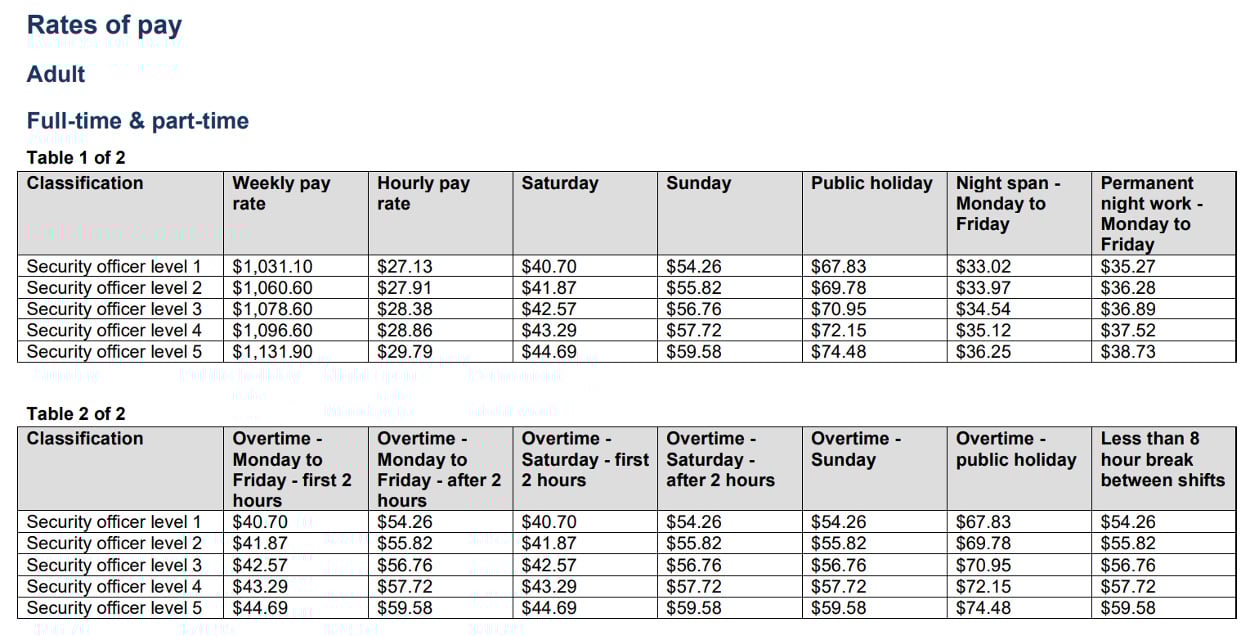
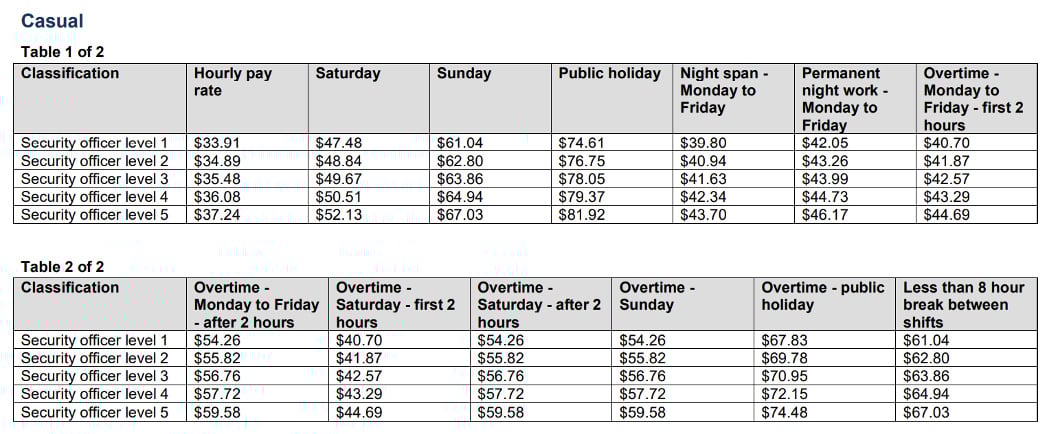
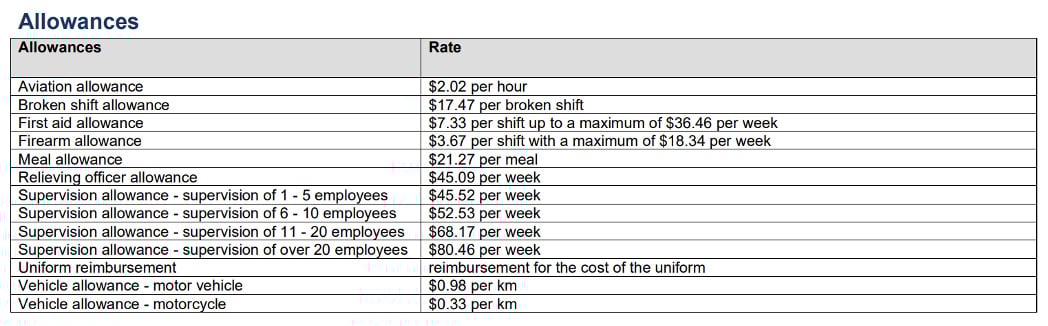
Exact Award rates vary and may change. Refer to the Security Services Industry Award 2020 for current rates.
Penalty Rates and Extra Income
Security officers typically have access to:
- weekend loadings
- evening/night penalties
- public holiday penalties
- overtime
- additional hours for major events and concerts
This is why many security officers earn significantly more than their base minimum rate over the course of a year.
Earning Potential and Career Progression
With experience, additional qualifications and strong performance, officers may progress into higher-paying roles such as:
- Control Room Operator
- Aviation Protection Officer
- Armed Security
- Cash-in-Transit
- Corporate Security
- Team Leader or supervisor
- Emergency Response or Safety Roles
- Security Risk Management Pathways
Security is one of the few industries where commitment, reliability and further training can quickly lead to increased earning potential.
Why Security Course Prices Vary Between RTOs
It’s common to see security courses advertised at different price points. However, these variations reflect real differences in quality, delivery, support and regulatory compliance.
Below is a detailed explanation of what drives training costs – and why choosing a reputable provider matters.
Training Facilities and Realistic Practice Environments
High-quality RTOs invest in training spaces that reflect real security environments, such as:
- scenario rooms
- communication equipment setups
- CCTV practice stations
- conflict management areas
- event and venue simulation spaces
These facilities allow students to practise real tasks before entering the workforce.
Low-cost providers may offer only minimal facilities, leading to limited practical exposure.
Trainer Experience and Industry Background
Training quality depends heavily on the expertise of the trainer.
Asset College trainers typically have backgrounds in:
- event security and crowd control,
- patrol and response,
- aviation and transport security,
- corporate and facility security,
- CIT and protective services.
This ensures students learn not just the theory, but the real, practical skills needed for the job.
Training Structure and Time Investment
Some RTOs deliver the absolute minimum contact hours, while others provide:
- extended practice time
- coaching during assessments
- deeper scenario training
- more learner support
These differences directly impact student confidence – and employer preference.
Student Support and Job-Readiness Services
Quality providers offer:
- LLND checks and support
- licensing guidance
- job application coaching
- employer engagement programs
- mentoring
- admin support for rebooking or rescheduling
These services improve student outcomes but also require investment.
Employer Partnerships and Industry Connections
Security companies prefer graduates from RTOs with a reputation for quality.
Asset College maintains partnerships with employers across Australia, supporting direct recruitment pathways, job expos and industry introductions.
This adds significant value to students who want real employment opportunities immediately after training.
Regulatory Compliance and Quality Assurance
Providers that meet or exceed ASQA standards invest heavily in quality assurance.
Cheaper providers sometimes cut corners – and it shows in the high number of certificate cancellations issued each year.
Choosing a compliant, reputable provider protects your qualification and career.
Choosing the Right Security Training Provider
The training provider you choose plays a major role not only in your learning experience but also in your confidence, safety, employability and long-term career progression. While price is an important consideration, the lowest fee does not always represent the best value.
Here are the key factors prospective students should consider when comparing RTOs:
Quality and Depth of Training
A good security course prepares you for real work – not just the assessment. Look for:
- realistic scenario-based training
- opportunities to practise communication, conflict management, incident response and observation skills
- trainers who can contextualise learning to real environments
- enough practical time to build confidence
Security is a job where people rely on you under pressure. Quality training matters.
Trainer Experience and Industry Knowledge
Experienced trainers from diverse security backgrounds bring insights that go beyond the textbook. Their guidance helps students understand:
- what employers expect
- how to avoid common mistakes
- how to read situations and respond safely
- what it’s really like to work in events, retail, corporate sites, aviation or CIT
This experience is hard to replicate in lower-cost, minimal-delivery programs.
Support Services and Student Experience
Training is easier when the provider offers:
- clear pre-course instructions
- LLND checks and early identification of support needs
- easy access to administrative support for bookings and licensing
- help navigating the application process for your security licence
- guidance on job readiness
These elements help students transition smoothly into both training and employment.
Industry Connections and Employment Pathways
Security employers prefer graduates from RTOs known for quality and professionalism.
Strong indicators of a provider’s reputation include:
- employer information sessions,
- job expos,
- introductions to local security companies,
- alumni success stories,
- large employer networks,
- opportunities to join major events or ongoing casual work.
Asset College maintains long-standing relationships with security employers nationwide, helping graduates connect with real job opportunities quickly.
Transparency and Compliance
Reputable RTOs provide:
- clear fee information
- a Schedule of Course Fees
- a Student Handbook
- straightforward refund and rescheduling policies
- qualified trainers
- compliant assessment practices
This protects students from unexpected costs and ensures the qualification remains valid.
Course Cost Comparison (2026 Fees)
Below is a quick reference guide summarising the 2026 pricing for the Certificate II in Security Operations.
| Pathway | 2026 Fee | Notes |
|---|---|---|
| Standard Course – Metro/Campus Delivery | $1500 | First Aid included. Licensing fees separate. |
| Standard Course – Regional Delivery | $1750 | Higher cost reflects regional delivery logistics. |
| QLD Career Start – Concession | $0 | Eligibility criteria apply. Skills Assure funded. |
| QLD Career Start – Non-Concession | $42 | Eligibility criteria apply. |
| Full RPL (where permitted) | $900 | Additional gap training fees may apply. |
Final Thoughts: Investing in Your Security Career
The Certificate II in Security Operations is the first major step toward a career with strong demand, flexible work opportunities and diverse pathways. Whether you’re entering the workforce for the first time, changing careers or looking for stable employment, choosing the right training provider makes all the difference.
A quality course ensures you:
- gain the practical skills to perform the role safely,
- understand legal and ethical responsibilities,
- build confidence in real-world scenarios,
- meet licensing requirements,
- and present well to employers who value professionalism and competence.
While low-cost options may seem appealing, the risk of poor-quality training – and potentially having your certificate cancelled – can cost far more in the long run. Investing in reputable, high-quality training supports your safety, job readiness and long-term career success.
How To Become a Full-Time Security Officer
The security industry continues to grow across Australia, driven by increased activity in retail, events, critical infrastructure, transport, health care and private sector organisations seeking stronger protective measures. While many people begin their careers working a mix of shifts, full-time opportunities are widely available for those who are well-trained, reliable and ready to step into professional roles.