
What Is the Phonetic Alphabet? Why It Matters in Security and Safety Roles
Clear and accurate communication is critical in security and safety roles. Security officers often work in noisy, crowded, or high-pressure environments where misunderstandings can quickly lead to errors, delays, or safety risks. Radio transmissions may be affected by interference, names and locations may be unfamiliar, and information often needs to be conveyed quickly and precisely.
The phonetic alphabet is a standardised system used to clearly spell words aloud by replacing individual letters with easily understood code words. Instead of saying a single letter such as “B” or “D”, which can sound similar over a radio, a speaker uses words like Bravo or Delta to reduce the risk of confusion.
Used across the security industry, emergency services, aviation, and other safety-critical sectors, the phonetic alphabet supports clear, professional communication. For security personnel, consistent use of the phonetic alphabet helps ensure that critical information is understood correctly the first time, particularly in situations where clarity directly affects safety outcomes.
What People Mean by “The Phonetic Alphabet”
When most people refer to “the phonetic alphabet”, they are talking about the NATO phonetic alphabet — the internationally recognised system that uses words such as Alpha, Bravo, and Charlie to represent letters of the English alphabet.
From a technical perspective, this system is more accurately described as the International Radiotelephony Spelling Alphabet. Its purpose is to spell words clearly during spoken communication, particularly over radios and telephones. However, the term “phonetic alphabet” has become widely used in everyday language, especially in security, policing, and emergency services, and is commonly understood to mean the NATO system.
This should not be confused with the International Phonetic Alphabet (IPA), which is a linguistic system used by language specialists to represent speech sounds. The IPA is not used in security work or radio communications and serves a completely different purpose.
In practical security contexts, the term “phonetic alphabet” is universally understood to mean the NATO phonetic alphabet, and this article uses the term in that everyday, professional sense.
What Is the NATO Phonetic Alphabet?
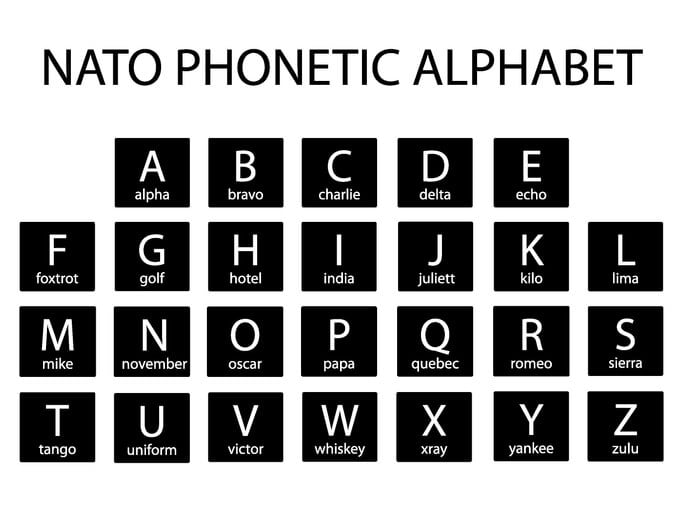
The NATO phonetic alphabet is an internationally standardised spelling alphabet designed to ensure letters are communicated clearly during spoken communication. Each letter of the English alphabet is assigned a specific word, such as Alpha for A, Bravo for B, and Charlie for C. When spelling a word aloud, each letter is replaced with its corresponding code word.
The system is designed for environments where communication may be affected by background noise, poor signal quality, time pressure, or differences in accent and pronunciation. Using full, recognisable words rather than single letters makes it far less likely that information will be misheard or misunderstood.
The NATO phonetic alphabet is used worldwide by security officers, police, emergency services, aviation professionals, military organisations, and control room operators. Its consistent use allows people from different organisations and backgrounds to communicate effectively using a shared standard.
In the security industry, the phonetic alphabet is commonly used during radio communications, when confirming names or identifiers, describing vehicle registration plates, spelling locations, and relaying incident details. Accurate communication in these situations supports safer operations, clearer reporting, and more effective coordination.
A Brief History of the Phonetic (Spelling) Alphabet
The need for a standardised spelling alphabet emerged alongside the development of long-distance communication technologies such as telegraphy and radio. Early voice communications were often unreliable, and individual letters could easily be misheard, particularly when transmitted over poor-quality lines or early radio systems.
Before a single international standard was adopted, many organisations and countries developed their own spelling alphabets. While these systems worked within local contexts, they caused confusion when different services or nations needed to communicate with one another. Words used to represent letters varied widely, and many were easily misunderstood by non-native English speakers.
To address these challenges, international testing was undertaken to develop a spelling alphabet that would remain clear across accents and under difficult communication conditions. After several revisions, the current NATO phonetic alphabet was formally adopted in 1956. Each word was carefully selected and tested to ensure it was distinct, pronounceable, and resistant to confusion when spoken over radio.
Since its adoption, the NATO phonetic alphabet has become the global standard for radiotelephony and spoken spelling, and is now used well beyond military contexts, including throughout the security and emergency services sectors.
The NATO Phonetic Alphabet (A–Z)
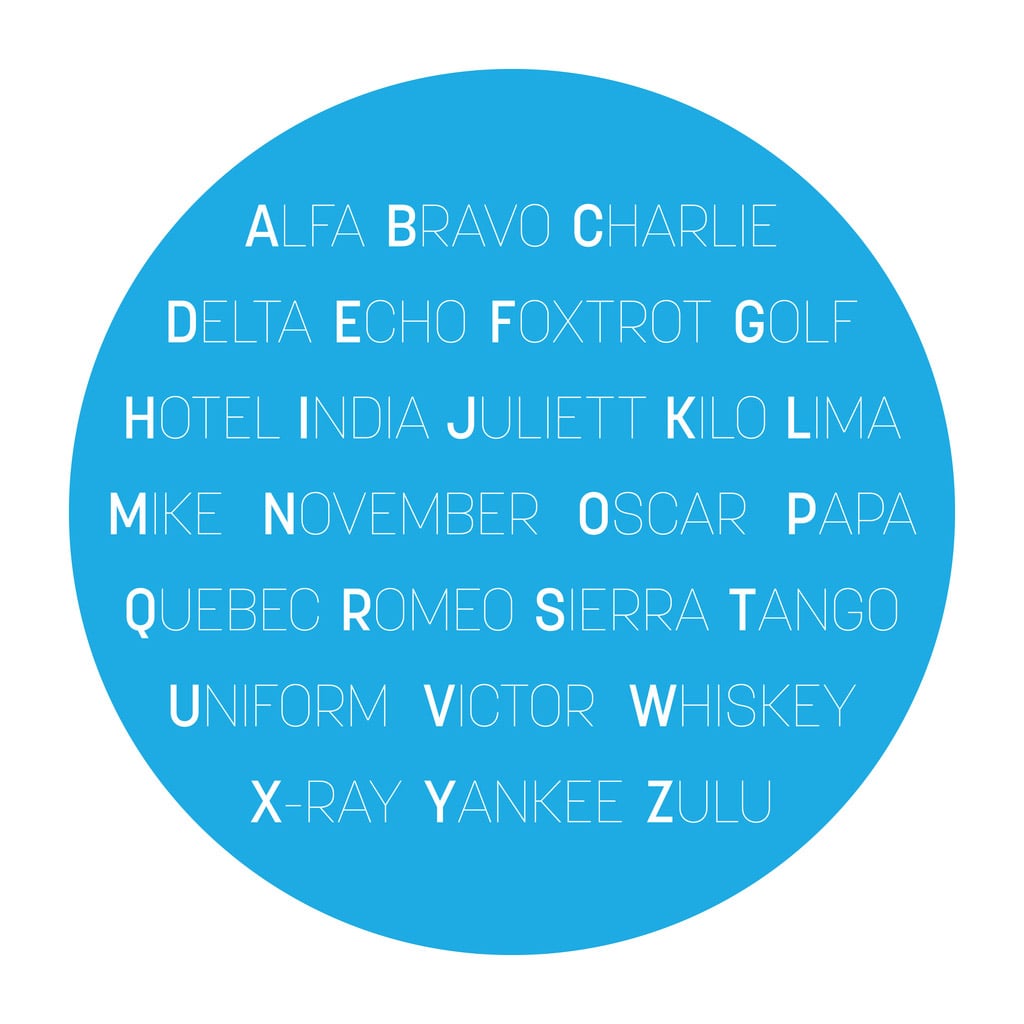
The NATO phonetic alphabet assigns a unique, standardised word to each letter of the English alphabet. When spelling a word aloud, each letter is replaced with its corresponding code word to ensure clarity and accuracy during spoken communication.
The table below shows the full NATO phonetic alphabet, along with a simple pronunciation guide. Pronunciation may vary slightly depending on accent, but clarity and consistency are more important than perfect pronunciation.
| Letter | Code word | Pronunciation (plain English) |
|---|---|---|
| A | Alpha | AL-fah |
| B | Bravo | BRAH-voh |
| C | Charlie | CHAR-lee |
| D | Delta | DELL-tah |
| E | Echo | ECK-oh |
| F | Foxtrot | FOKS-trot |
| G | Golf | GOLF |
| H | Hotel | hoh-TELL |
| I | India | IN-dee-ah |
| J | Juliett | JEW-lee-ett |
| K | Kilo | KEY-loh |
| L | Lima | LEE-mah |
| M | Mike | MIKE |
| N | November | no-VEM-ber |
| O | Oscar | OSS-kah |
| P | Papa | pah-PAH |
| Q | Quebec | keh-BECK |
| R | Romeo | ROW-me-oh |
| S | Sierra | see-AIR-rah |
| T | Tango | TANG-go |
| U | Uniform | YOU-nee-form |
| V | Victor | VIK-tah |
| W | Whiskey | WISS-key |
| X | X-ray | ECKS-ray |
| Y | Yankee | YANG-key |
| Z | Zulu | ZOO-loo |
Note: Spellings reflect the official NATO standard (for example, “Juliett” is spelled with two Ts).
Why These Words Are Used
The words in the NATO phonetic alphabet were carefully chosen to reduce the likelihood of misunderstanding during spoken communication. Each word was tested to ensure it sounds distinct from others, even when spoken quickly, over poor-quality radio signals, or by people with different accents.
Many letters of the alphabet sound similar when spoken on their own. Letters such as “B”, “D”, “P”, and “T” are easily confused, particularly in noisy environments or over two-way radios. Replacing these letters with words like Bravo, Delta, Papa, and Tango significantly reduces the risk of error.
The code words were also selected to be recognisable and pronounceable by non-native English speakers. This is particularly important in international and multi-agency environments, where people from different backgrounds may need to communicate clearly using a shared system.
For security operations, where information may need to be acted on immediately, the use of these standardised words helps ensure that critical details are received accurately the first time, supporting safer and more efficient outcomes.
How the Phonetic Alphabet Is Used in Security Work
In the security industry, the phonetic alphabet is used wherever clear and reliable verbal communication is required. Security officers frequently rely on two-way radios, particularly in large venues, busy public spaces, or during incidents where rapid coordination is essential.
Common situations where the phonetic alphabet is used include spelling names, confirming locations, identifying vehicle registration plates, and relaying descriptions of people or property. It is also widely used when communicating between patrol officers and control rooms, where background noise, distance, or radio interference may affect clarity.
Consistent use of the phonetic alphabet supports effective teamwork. When all personnel use the same standard words, information can be shared efficiently without repeated clarification. This becomes especially important during incidents, where miscommunication can delay responses or lead to incorrect decisions.
Clear verbal communication also supports accurate written records. Information that is communicated clearly is more likely to be recorded correctly in notebooks, logs, and incident reports, which can be important for follow-up actions, investigations, or compliance requirements.
Best Practice and Common Mistakes
To use the phonetic alphabet effectively, security personnel should follow standard best practice. This includes always using the recognised NATO code words rather than creating alternatives. While phrases such as “S for Sugar” or “C for Cat” may seem helpful, they can create confusion if the listener expects the standard system.
Best practice includes:
- speaking clearly and at a steady pace
- using the full code word for each letter
- repeating or confirming critical information when required
Common mistakes include mixing ordinary letters with phonetic code words, rushing through spellings, or only using the phonetic alphabet when communication becomes difficult. In professional security work, consistent use of the phonetic alphabet is preferable, even when conditions seem clear.
Using the phonetic alphabet correctly and consistently helps reduce errors, improves communication efficiency, and supports the professional standards expected of licensed security officers.
Learning and Practising the Phonetic Alphabet
The phonetic alphabet is a skill that improves with regular practice. Security officers are often expected to recall and apply the phonetic alphabet quickly, sometimes under pressure, without needing to refer to notes.
Practical learning methods include spelling names, locations, or vehicle registrations during training exercises, particularly when using radios. Role-plays and simulated scenarios help build familiarity and confidence, especially when conducted in environments that reflect real workplace conditions.
Developing this skill early supports clearer communication throughout a security career. For many security officers, the phonetic alphabet is introduced during formal training and reinforced during licensing and refresher courses, helping ensure consistent communication standards across the industry.
Security Training with Asset College
Clear communication is a core skill in professional security work, and the correct use of the phonetic alphabet forms part of the broader communication standards expected of licensed security officers.
Asset College delivers nationally recognised security training and security licence courses across Australia. Our programs focus on practical, real-world skills, including effective radio communication, incident reporting, and working confidently in operational environments.
Whether you are entering the security industry for the first time or renewing or upgrading your security licence, quality training helps ensure you are prepared to meet workplace expectations and regulatory requirements.
To learn more, explore our security licence courses or browse our nationally recognised security qualifications to find the training pathway that aligns with your goals.
Radio Communications for Security Officers
Clear and reliable radio communication is a core skill for security officers. In many security environments, two-way radios are the primary method of communication between officers, supervisors, and control rooms. Whether working in a busy public venue, a large site, or during an incident, the ability to communicate clearly over the radio supports safety, coordination, and effective decision-making.