

Introduction: Why Full-Time Security Roles Are in Demand
The security industry continues to grow across Australia, driven by increased activity in retail, events, critical infrastructure, transport, health care and private sector organisations seeking stronger protective measures. While many people begin their careers working a mix of shifts, full-time opportunities are widely available for those who are well-trained, reliable and ready to step into professional roles.
Security isn’t just a stop-gap job — it’s a long-term career with pathways into specialist areas such as investigations, risk management, cyber security, aviation and maritime security, emergency response and operational leadership. Employers look for people who take their training seriously, understand their responsibilities and can represent their organisation with professionalism.
Choosing the right training provider plays a major role in how quickly you move into full-time employment. Reputable organisations with proven industry relationships are recognised by employers, which can make a significant difference when you begin applying for work. Asset College has long-established connections with major security companies and runs regular employer engagement events, giving graduates access to real opportunities across a wide range of sectors.
Full-time roles are achievable — and for many graduates, they come sooner than expected when the training foundation is strong and employers know they can trust the quality of the provider.
What Employers Look for in Full-Time Security Officers
Full-time security roles are typically offered to people who demonstrate the right mix of professionalism, reliability and practical capability. While licences and qualifications are essential, employers consistently highlight several qualities that influence who they hire — and who they promote into stable, long-term
| Professional communication | Professional communication Security officers represent their employer and the client site. Clear, respectful communication is essential, whether dealing with members of the public, writing reports or relaying information to a control room or supervisor. |
|---|---|
| Reliability and presentation | Turning up on time, maintaining professional appearance standards and completing required tasks without supervision makes a strong impression. Employers want people they can confidently schedule into ongoing rosters. |
| Situational awareness and sound judgement | Security work often involves identifying risks early and responding appropriately. Officers who stay alert, remain calm and follow procedures are trusted with more responsibility and more stable shifts. |
| A commitment to quality training | Employers pay close attention to where an applicant completed their training. Well-established RTOs with industry credibility give employers confidence that the graduate has been trained to a high standard. Asset College’s reputation for producing job-ready graduates is well recognised across the industry. Many employers actively attend our recruitment events and request applications from our students because they understand the level of training delivered. |
| A willingness to learn and progress | Full-time roles often go to those who show interest in building their skills beyond the minimum licensing requirement. This includes further study in areas such as control room operations, aviation security, investigations, risk, cyber or supervisory training. |

Step 1: Complete Your Security Training With a Trusted Provider
Becoming a full-time security officer starts with completing the right qualification — the Certificate II in Security Operations. This course provides the core skills needed for entry-level roles, including communication, incident response, legal responsibilities and practical techniques for maintaining safety.
While the qualification itself is the same nationwide, the quality of training varies considerably between providers. Employers are well aware of this. They look for applicants who have trained with organisations known for delivering strong fundamentals, realistic scenarios and high engagement standards.
Why your choice of training provider matters
A reputable RTO not only teaches the required content but also prepares you to work confidently from day one. This includes:
- Practical assessments that reflect real workplace environments
- Trainers with current industry experience
- Clear guidance on the licensing process
- Expectations aligned with industry standards
Importantly, your choice of provider can influence how quickly you move into stable employment. Many companies recruit from trusted training organisations because they know graduates have been properly prepared.
Asset College’s advantage
Asset College has long-standing connections with major security employers across Australia. Our graduates benefit from:
- Regular employer information and recruitment sessions
- Direct engagement with companies actively seeking new officers
- A reputation for producing well-prepared, professional candidates
- Pathways into specialised fields beyond general guarding
While we never guarantee employment, these partnerships provide graduates with genuine opportunities to pursue full-time work soon after gaining their licence.
Completing high-quality training is the first — and most important — step in establishing yourself as a strong applicant who employers want to place in ongoing roles.

Step 2: Apply for Your Security Licence
Once you’ve completed your training, the next step is applying for your security licence. Each state and territory has its own licensing authority and specific requirements, but the overall process is similar across Australia.
Applicants generally need to:
- Provide evidence of completing an approved security training course
- Meet eligibility requirements such as identity checks and background screening
- Hold a current first aid certificate
- Submit the required application forms and fees
Most applicants receive their licence within a few weeks, depending on processing times in their state or territory.
Asset College supports students through this stage by providing clear instructions, guidance on the documents required and an overview of the steps involved for the jurisdiction they intend to work in. While we don’t handle the application on a student’s behalf, our team ensures you understand what to expect so you can transition smoothly into the workforce.
With your licence approved, you’re ready to start applying for security roles and building the experience that leads to full-time employment.

Start Work and Build Experience
Most new security officers begin with a mixture of casual and part-time shifts. This is normal across the industry and reflects the variety of sites, hours and contract arrangements security companies manage. These early shifts are valuable — they allow you to build experience, demonstrate reliability and become familiar with different environments such as retail centres, corporate buildings, events and mobile patrols.
Why early experience matters
Security companies place a strong emphasis on proven performance. Officers who consistently turn up on time, follow procedures, communicate clearly and manage incidents calmly are the ones employers quickly place into more regular and ongoing rosters.
In many cases, full-time work becomes available once you have:
- Shown you can handle a range of responsibilities
- Demonstrated strong customer service and communication
- Maintained professional presentation and behaviour
- Developed a reputation for reliability and teamwork
These are the factors supervisors and roster coordinators rely on when filling stable positions.
Support during the job-seeking stage
Asset College graduates benefit from exposure to multiple employers through recruitment events and industry connections. Many students secure their first shifts soon after licensing because employers recognise the standard of training and are confident in the capability of our candidates.
While full-time roles are not guaranteed, building early experience — combined with training from a respected provider — places you in a strong position to be offered permanent hours as opportunities arise.
Where Full-Time Security Jobs Are Most Common
Full-time positions exist across a wide range of security environments. While some sectors rely heavily on casual and event-based staffing, others operate around the clock and require stable, permanent teams. Understanding where full-time opportunities are more common can help you target the right employers from the start.
Corporate and commercial security | Office towers, business parks and high-profile commercial sites often maintain dedicated full-time security teams. These roles focus on access control, customer service, incident response and monitoring. |
|---|---|
Government and critical infrastructure | Utilities, transport hubs, government buildings and essential services rely on highly consistent security coverage. Permanent roles are common, and additional clearances or specialised training can enhance employability. |
Retail and shopping centres | Major shopping centres, retail precincts and supermarkets maintain constant security coverage to support loss prevention, customer safety and incident response. Full-time officer roles are common due to extended trading hours and consistent foot traffic. |
Education and university campuses | Universities, TAFEs and large schools operate sizeable security teams responsible for campus patrols, access management, incident response and after-hours safety. These environments often offer stable, full-time roster lines. |
Manufacturing and industrial sites | Factories, warehouses, logistics hubs and distribution centres require continuous security presence to manage access control, protect assets and oversee vehicle movements. Full-time guarding and gatehouse roles are widely available. |
Residential and concierge security | High-rise apartments, gated communities and residential complexes frequently employ full-time concierge or front-of-house security officers. These roles focus on access control, resident support and monitoring of building activity. |
Aviation security | Airports require large security workforces across screening, patrols, gate operations and secure area monitoring. Full-time shifts are typical due to the scale and continuity of operations. |
Maritime security | Ports and maritime facilities operate under strict security requirements, creating opportunities for full-time officers in screening, patrols and access control roles. |
Health care facilities | Major hospitals and health precincts maintain ongoing security presence to support staff safety, manage incidents and assist with patient and visitor flow. These settings commonly provide full-time roster lines. |
Control rooms and monitoring centres | Control rooms operate 24/7 and require permanently staffed shifts. Officers in these roles are responsible for alarm response, CCTV monitoring, communications and coordination. |
Mobile patrols | Patrol operations typically run on structured rosters, making full-time work more accessible for officers who enjoy a varied, fast-paced role. |
Full-time roles are not limited to one part of the industry. Because Asset College delivers training across security operations, aviation, maritime, risk, cyber, control room functions and investigations, students are well positioned to explore a wide range of sectors as they build their careers.
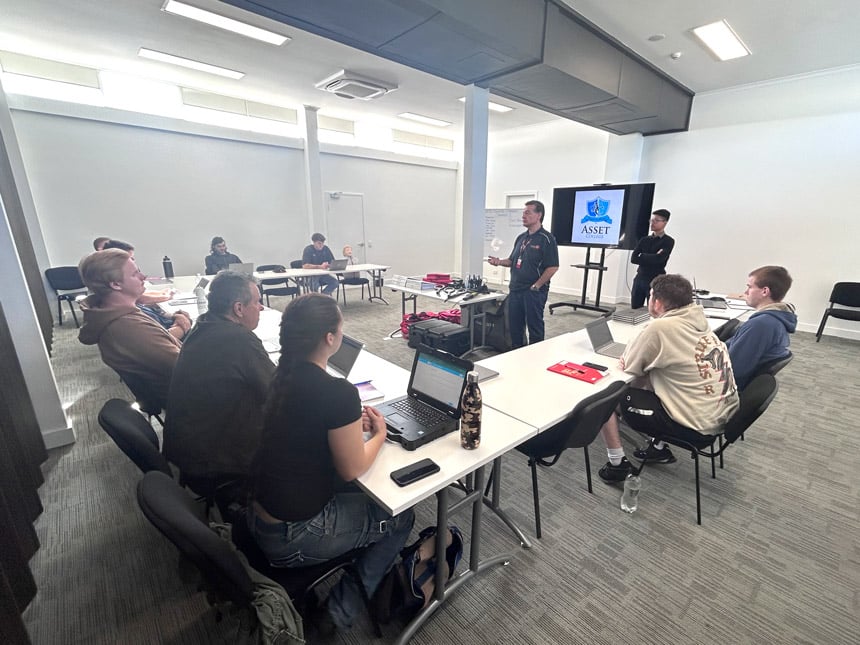
How Training With Asset College Improves Your Employment Prospects
While no provider can guarantee employment, your choice of RTO has a measurable impact on how quickly you secure work and the types of opportunities available to you. Employers look for candidates who have been trained well, understand their responsibilities and are ready to step into real operational environments. Asset College has built a strong reputation across Australia for producing graduates who meet these expectations.
Industry-recognised training
Our courses are delivered by experienced trainers with extensive operational backgrounds. Graduates leave with practical skills, realistic scenario experience and the confidence needed to perform effectively on shift.
Established employer relationships
Many of Australia’s major security companies actively recruit from Asset College. They know our graduates are well-prepared and job-ready. We regularly host employer information sessions, recruitment events and presentations where students can meet hiring managers directly.
Strong connections to multiple sectors
Because Asset College also delivers training in areas such as investigations, aviation security, maritime security, risk management and cyber security, employers understand that our students are exposed to higher standards of professionalism and a broader view of the industry.
Support through the early stages of your career
We guide students through the steps from training to licensing and job applications. Our team provides clear information on industry expectations, resume preparation and options for further study that strengthen employability.
Pathways for long-term progression
Full-time work often becomes accessible sooner when you combine a strong training foundation with a commitment to ongoing learning. Asset College offers additional qualifications and short courses that support career advancement into supervisory, specialised and technical roles.
Training with a reputable provider not only equips you with core skills — it opens doors. Many employers prioritise applications from Asset College graduates because they recognise the level of preparation and professional standards embedded throughout our programs.
Tips for Securing a Full-Time Role Quickly
Full-time security positions are achievable, but like any profession, preparation and attitude make a significant difference. Graduates who progress into stable employment fastest tend to approach the early stages of their career with clear purpose and professionalism.
Present a strong, industry-ready resume
A concise and well-structured resume helps employers identify your suitability quickly. Highlight your training, licences, availability, communication skills and any previous customer-facing experience. Many first-time security employers value reliability and attitude as much as technical skills.
Apply across different sectors
Limiting yourself to one type of role, such as retail or static guarding, can slow the move into full-time work. Consider aviation, health care, mobile patrols, control rooms or corporate environments — each offers distinct opportunities and roster patterns.
Make a strong first impression
Arriving early, maintaining professional presentation and demonstrating good communication are consistently cited by employers as key reasons they offer permanent shifts to new officers.
Be flexible in the beginning
Full-time work often follows a period of mixed shifts. Showing willingness to take on nights, weekends or short-notice shifts can help you build trust with roster coordinators and supervisors.
Seek feedback and keep improving
Early jobs provide valuable learning moments. Officers who seek feedback, follow procedures and show initiative tend to progress more quickly into permanent roles.
Upskill early to stand out
Qualifications or micro-credentials in areas such as control room operations, first aid, conflict management, customer service, aviation screening or investigations can help you access more specialised and stable positions. Employers take note when a new officer is investing in their professional development.
With a proactive approach and support from a reputable training provider, most graduates find that full-time roles are well within reach — often sooner than they expect.

Career Progression and Ongoing Training
A full-time role is often the starting point, not the destination. One of the strengths of the security industry is the wide range of pathways available as you gain experience. Many officers build rewarding careers by moving into specialised roles, supervisory positions or technical fields that require additional training.
Specialist operational roles
As you develop confidence and capability, opportunities may open in areas such as:
- Control room operations
- Mobile patrols
- Event and venue management
- Aviation or maritime security
- Hospital and critical infrastructure security
These roles often come with more structured rosters and clearer pathways into full-time employment.
Investigations and compliance roles
Some officers progress into private investigations, surveillance, regulatory compliance or workplace investigations. These pathways suit individuals with strong communication and analytical skills.
Risk management and leadership
Officers with an interest in organisational safety, emergency planning or supervision can move into leadership roles or pursue qualifications in security risk management. These roles typically offer full-time employment with greater responsibility.
Cyber and technical security
As physical and digital security continue to converge, demand is growing for professionals who understand both domains. Officers with strong problem-solving skills sometimes transition into cyber security foundations or protective security roles.
Supporting your progression through training
Asset College offers a broad suite of qualifications and short courses that align with industry needs. Whether you want to specialise, broaden your capabilities or prepare for leadership, ongoing training supports long-term career growth and enhances your employability across multiple sectors.
Final Thoughts: Your Pathway to Full-Time Employment Starts With the Right Training
Securing full-time work as a security officer is an achievable goal for anyone prepared to train well, meet industry expectations and approach the role with professionalism. The demand for reliable, well-trained officers continues to grow across Australia, creating real opportunities for people seeking stable, meaningful employment.
Your training provider plays a significant role in shaping your success. High-quality training, industry-experienced trainers and strong employer connections all contribute to how confidently you enter the workforce and how quickly you move into ongoing roles. Asset College’s well-established reputation and partnerships with major employers give graduates valuable exposure to real job opportunities without making promises we cannot guarantee.
With the right preparation, a willingness to learn and a commitment to developing your skills, full-time security work can become the foundation for a long and rewarding career — whether you choose to specialise, progress into leadership or explore wider fields such as investigations, risk or cyber security.
Full Time Security Officer – ‘It’s the best job I have ever had!’
Before signing up with Asset College into our Certificate III in Security Operations course Brendan was working in sales. He was also doing some personal training but found himself needing a career change and fast! Brendan set out to do some research to see what career pathways might be more sustainable for his future and found Asset College in his search online.